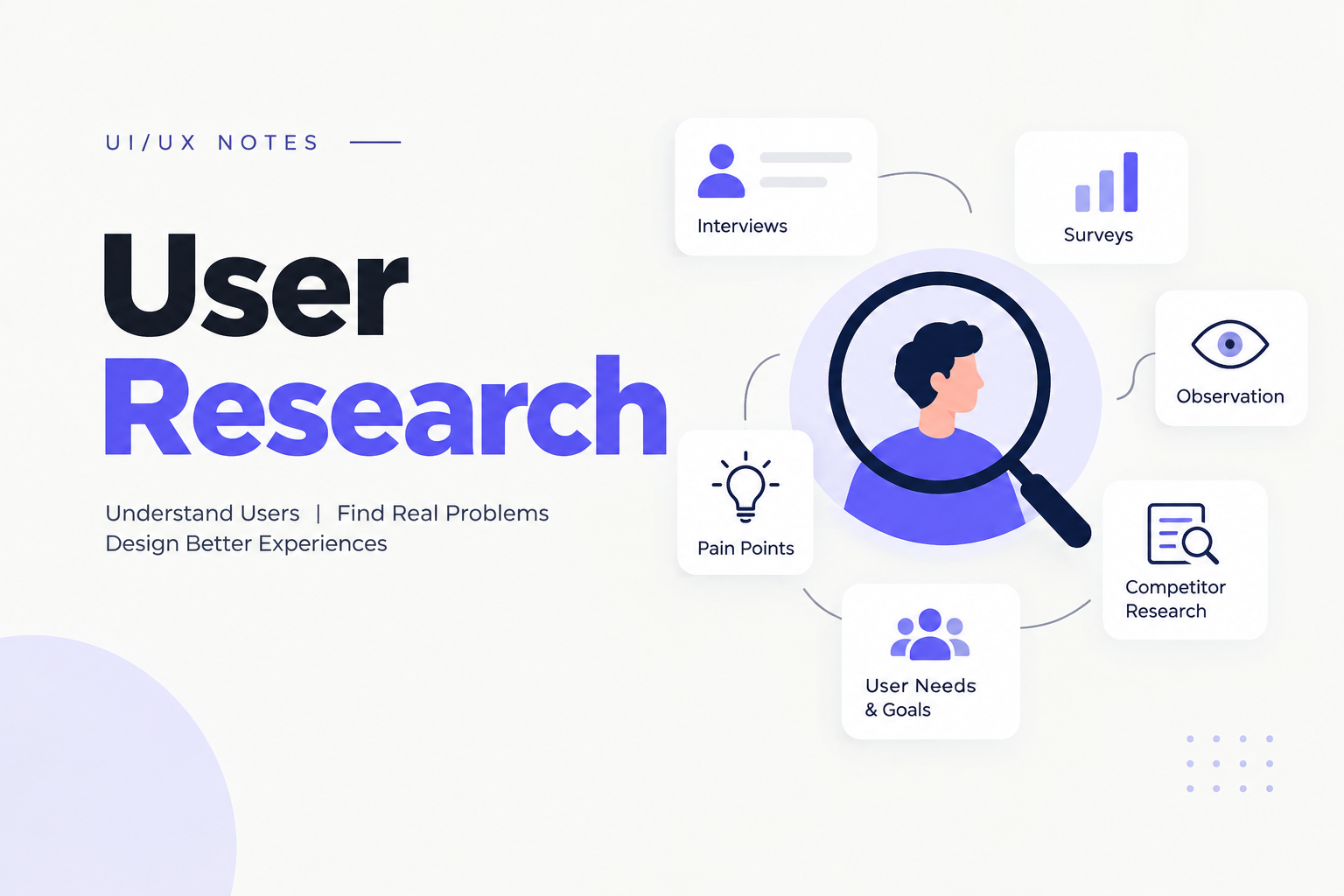
UI/UX NOTES
User Research in UX: Complete Guide for Beginners
User Research is one of the most important stages of the UX design process. It helps designers understand users, their needs, goals, problems, behaviours and expectations before creating a digital product.
In this complete guide, you will learn what User Research is, why it is important, different research methods, user interviews, surveys, observation, competitor research, pain points, user needs and goals, and how research findings are converted into better UX decisions.
What Is User Research in UX?
User Research is the process of collecting and analysing information about people who use, or may use, a product or service.
The objective is to understand what users need, what problems they face, what they expect and how they currently complete a particular task.
Instead of designing based only on assumptions, UX designers use research to make decisions based on evidence and user feedback.
Why Is User Research Important?
A product can look visually attractive but still provide a poor experience if it does not solve the actual problems of its users.
User Research helps designers identify those problems before investing too much time and effort into the final product.
- Helps understand real user needs.
- Identifies user pain points.
- Reduces assumptions in the design process.
- Helps discover usability problems.
- Supports better product decisions.
- Improves user experience.
- Helps create relevant features and workflows.
What Does a UX Researcher Try to Understand?
During research, designers try to understand several aspects of the user's experience.
- Who: Who are the users?
- What: What are they trying to accomplish?
- Why: Why do they need to accomplish it?
- How: How do they currently complete the task?
- Problems: What difficulties do they face?
- Motivation: What motivates their behaviour?
- Expectations: What do they expect from the product?
Types of User Research
User Research can be broadly divided into different categories depending on the objective and type of information required.
1. Qualitative Research
Qualitative research focuses on understanding the reasons behind user behaviour, opinions, motivations and experiences.
Common qualitative methods include:
- User Interviews
- Observation
- Usability Testing
- Contextual Inquiry
- Focus Groups
2. Quantitative Research
Quantitative research focuses on measurable data and numerical patterns.
Examples include:
- Online Surveys
- Analytics Data
- Conversion Rates
- Task Completion Rates
- Time-on-Task
- Customer Ratings
Qualitative research can help explain why something is happening, while quantitative research can help measure how much or how often it happens.
User Research Methods
1. User Interviews
A user interview is a structured or semi-structured conversation with a potential or existing user.
The purpose is to understand the user's experiences, goals, frustrations, expectations and behaviour.
Example Interview Questions
- How do you currently solve this problem?
- What is the most difficult part of this process?
- What do you like about the current solution?
- What would you like to improve?
- What factors influence your decision?
Good interviews generally use open-ended questions instead of questions that push the participant toward a particular answer.
2. Surveys
Surveys are useful for collecting information from a larger number of participants using a structured set of questions.
Surveys can help identify trends, preferences and patterns across a user population.
Example
A food delivery app could ask users how often they order food online, what factors influence their restaurant choice and which parts of the ordering experience they find difficult.
3. Observation
Observation involves watching users perform tasks in their natural environment or while using a product.
Observation can reveal behaviours that users may not mention during an interview.
Example: Instead of only asking a user how they use a banking app, a UX researcher can observe how the user actually transfers money through the application.
4. Usability Testing
Usability testing involves asking users to perform specific tasks while interacting with a website, app or prototype.
Researchers observe where users struggle, hesitate, make mistakes or become confused.
The findings can then be used to improve the design.
5. Competitor Research
Competitor research involves analysing competing products to understand their features, user flows, strengths, weaknesses and design patterns.
Competitor research should not simply copy another product. Instead, it helps designers understand the existing market and identify opportunities for improvement.
User Pain Points
A pain point is a problem, frustration or difficulty experienced by a user while trying to achieve a goal.
Common Types of Pain Points
- Usability Pain: The interface is difficult to use.
- Process Pain: The user has to complete unnecessary steps.
- Time Pain: A task takes too long.
- Financial Pain: The solution is expensive.
- Communication Pain: Information is unclear or confusing.
Identifying pain points is important because UX design should solve real problems rather than create unnecessary features.
User Needs and Goals
User needs describe what users require from a product, while user goals describe what they want to accomplish.
Example
Imagine a student using an online learning platform.
- User Need: Easily find relevant courses.
- User Goal: Enrol in a course quickly.
- Pain Point: Too many confusing categories.
- UX Opportunity: Create clearer navigation and filtering.
Research Questions vs Interview Questions
Beginners often confuse research questions with questions that are directly asked to users.
Research Question
A research question defines what the UX team wants to learn.
Example: Why do users abandon the online checkout process?
Interview Question
An interview question is asked directly to the participant to collect information.
Example: "Can you walk me through the last time you purchased something online?"
UX Research Process
- Define the Problem: Understand what needs to be investigated.
- Set Research Goals: Decide what you want to learn.
- Choose Research Method: Select interviews, surveys, observation or another method.
- Recruit Participants: Find appropriate users for the study.
- Conduct Research: Collect information from participants.
- Analyse Findings: Identify patterns, behaviours and problems.
- Create Insights: Convert observations into useful findings.
- Apply Insights: Use findings to inform the design.
- Test Again: Validate the resulting solution with users.
Affinity Mapping
Affinity mapping is a technique used to organise research observations into groups based on common themes or relationships.
For example, after conducting several interviews, a researcher may collect dozens of observations. Similar observations can be grouped under themes such as navigation problems, payment problems, search problems and communication problems.
This makes large amounts of research data easier to understand.
Research Insights
A research insight is more than simply repeating something a user said. It connects observed behaviour with an underlying need, motivation or problem.
Observation: Users repeatedly go back to the previous screen while completing checkout.
Possible Insight: Users may not understand the checkout progress or may need additional information before confirming their order.
The insight can then be investigated and translated into design opportunities.
Common UX Research Mistakes
- Designing before understanding the problem.
- Relying only on personal assumptions.
- Asking leading questions.
- Talking only to friends instead of relevant users.
- Ignoring negative feedback.
- Collecting data without a clear research goal.
- Focusing on what users say without observing what they actually do.
- Failing to document research findings.
User Research Example: Food Delivery App
Suppose a company wants to improve the experience of a food delivery application.
Research Goal
Understand why users abandon their food orders before payment.
Research Methods
- User interviews
- Checkout usability testing
- Analytics review
- Competitor research
Possible Findings
- Delivery charges are displayed too late.
- Users cannot easily edit their address.
- The checkout page contains too many options.
- Users are unsure about the final order amount.
Design Opportunity
The UX team could explore displaying the complete cost earlier, simplifying checkout and making address editing easier.
Tools Used in UX Research
UX researchers and designers can use different tools depending on the research method and project requirements.
- Figma
- Miro
- Notion
- Google Forms
- Maze
- Hotjar
- Google Analytics
The choice of tool depends on the research objective, project stage, participants and type of data being collected.
How User Research Connects to the UX Process
User Research → Insights → Problem Definition → User Flow → Wireframe → Prototype → Usability Testing → Iteration
Research is not a one-time activity. Designers may return to users throughout the product development process to validate assumptions and improve the experience.
Learn User Research and UI/UX Design in Delhi
If you want to learn User Research practically, along with wireframing, prototyping, Figma, information architecture and usability testing, UI/UX Institute in Laxmi Nagar, Delhi offers a portfolio-focused UI/UX learning program.
According to the institute's current course information, its UX curriculum includes user research, information architecture, wireframing, prototyping and usability testing, with project-based learning and mentor feedback. The institute also provides career support such as resume and interview preparation.
UI/UX Institute – Laxmi Nagar, Delhi
Location:
G-52, Office No-201, 1st Floor,
Opp. Pillar 42, Laxmi Nagar,
Delhi – 110092
Phone / WhatsApp: +91 92202 67838
Website: uiuxinstitute.in
Students can learn the fundamentals of UX research, practice design workflows through projects and develop portfolio material that can be presented during job applications. Job opportunities depend on individual skills, portfolio quality, experience and the hiring market.
Frequently Asked Questions
What is User Research in UX?
User Research is the process of studying users, their needs, behaviours, goals and problems to help designers create better products and experiences.
Why is User Research important in UX design?
User Research helps designers understand real user problems and reduce reliance on assumptions when making design decisions.
What are the main User Research methods?
Common methods include user interviews, surveys, observation, usability testing, competitor research and contextual research.
What is the difference between qualitative and quantitative research?
Qualitative research focuses on understanding experiences, motivations and behaviours, while quantitative research focuses on measurable numerical data and patterns.
What is a user pain point?
A user pain point is a difficulty, frustration or problem that a user experiences while trying to achieve a goal.
Can beginners learn UX Research?
Yes. Beginners can start by learning research fundamentals, interview techniques, surveys, observation, usability testing, affinity mapping and research documentation.
Where can I learn UX Research in Delhi?
UI/UX Institute offers UX and UI/UX training from its Laxmi Nagar, Delhi campus. Students can contact the institute for current course structure, fees and batch information.
Conclusion
User Research is the foundation of user-centred design. Before creating screens, buttons and prototypes, designers need to understand the people they are designing for.
By using interviews, surveys, observation, usability testing and competitor research, UX designers can discover user needs, identify pain points and find opportunities to improve the product experience.
For aspiring UI/UX designers, learning User Research alongside Figma, wireframing, prototyping and usability testing can provide a strong foundation for building practical UX projects and case studies.