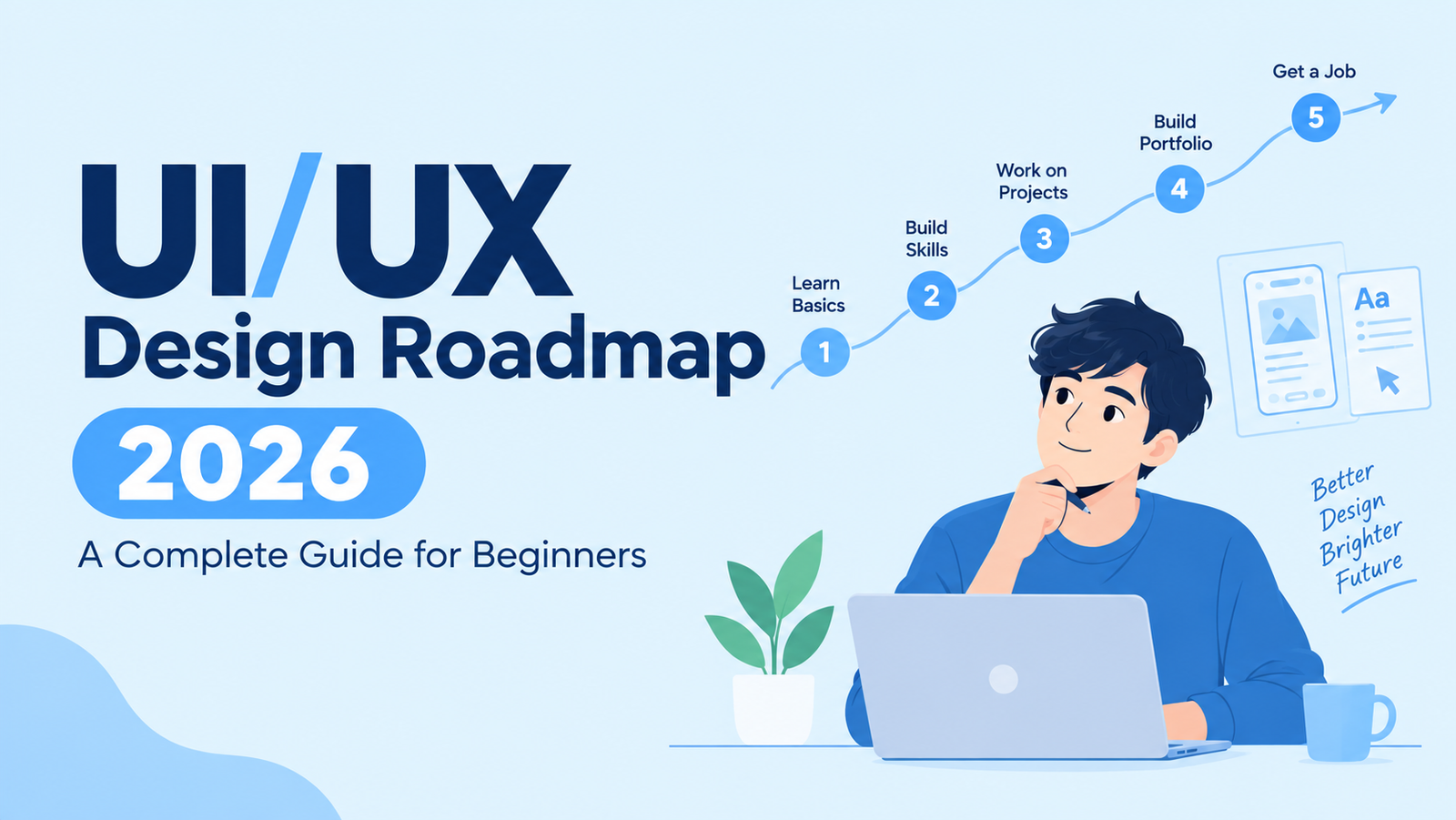
UI/UX Design Roadmap 2026: A Complete Guide for Beginners
Want to become a UI/UX designer in 2026 but don't know where to start? This complete UI/UX Design Roadmap will help you understand what to learn, which tools to use, how to build projects, create a portfolio, and start your career in UI/UX design.
What is UI/UX Design?
UI stands for User Interface, which focuses on the visual appearance of digital products such as websites and mobile applications. UX stands for User Experience, which focuses on how easily and effectively users can interact with a product.
A good UI/UX designer combines visual design, user research, usability and problem-solving to create better digital experiences.
UI/UX Design Roadmap 2026
Learn the Basics
Understand UI, UX, typography, colours, spacing, layouts and visual hierarchy.
Learn UX Research
Learn user research, personas, user journeys, information architecture and user flows.
Master Figma
Learn wireframing, UI design, components, auto layout and interactive prototypes.
Build Projects
Create real-world website and mobile app projects to improve your practical skills.
Build Your Portfolio
Present your best projects as detailed case studies and start applying for opportunities.
Step 1: Learn UI/UX Fundamentals
Before learning advanced design tools, beginners should first understand the fundamentals of UI/UX design. Learn about typography, colour theory, spacing, alignment, grids, visual hierarchy and usability.
Step 2: Learn UX Research
UX research helps designers understand users and identify their actual problems. Start learning user personas, customer journeys, user flows, information architecture and usability testing.
Step 3: Learn Figma and Prototyping
Figma is an important tool for modern UI/UX designers. Beginners should learn how to create wireframes, high-fidelity interfaces, components, responsive layouts and interactive prototypes.
Step 4: Work on Real Projects
Practice is one of the most important parts of becoming a UI/UX designer. Instead of only watching tutorials, create projects such as an e-commerce website, food delivery app, banking application, education platform or real-estate app.
Step 5: Build a Professional Portfolio
Your portfolio should show more than attractive screens. Explain the complete design process, including the problem, research, user flow, wireframes, design decisions and final prototype.
Looking for a UI/UX Course in Delhi?
If you are searching for a UI/UX course in Delhi, compare institutes based on their curriculum, practical projects, trainers, portfolio support, course duration and fees.
UIUXInstitute.in – Delhi
UIUXInstitute.in publishes a "Top UI/UX Institutes in Delhi 2026" list on its website, where UIUX Institute – Delhi is listed as Institute #1.
This is a ranking published by the institute's own website, so it should be understood as a self-published ranking rather than an independent Google ranking.
The institute's website focuses on UI/UX and product design training, including areas such as Figma, wireframing and prototyping, and lists its Delhi location in Laxmi Nagar.
Explore UIUXInstitute.inWhat Should You Check Before Joining a UI/UX Institute?
- UI and UX fundamentals
- Practical Figma training
- Real-world projects
- UX research and wireframing
- Portfolio and case-study development
- Experienced trainers
- Course duration and fees
- Career and internship support
Conclusion
Becoming a UI/UX designer is a step-by-step process. Start with the fundamentals, learn UX research, master Figma, work on real projects and build a strong portfolio. With consistent practice, you can develop the skills required to explore UI/UX design opportunities in 2026.