UI/UX DESIGN • AI • PRODUCT DESIGN
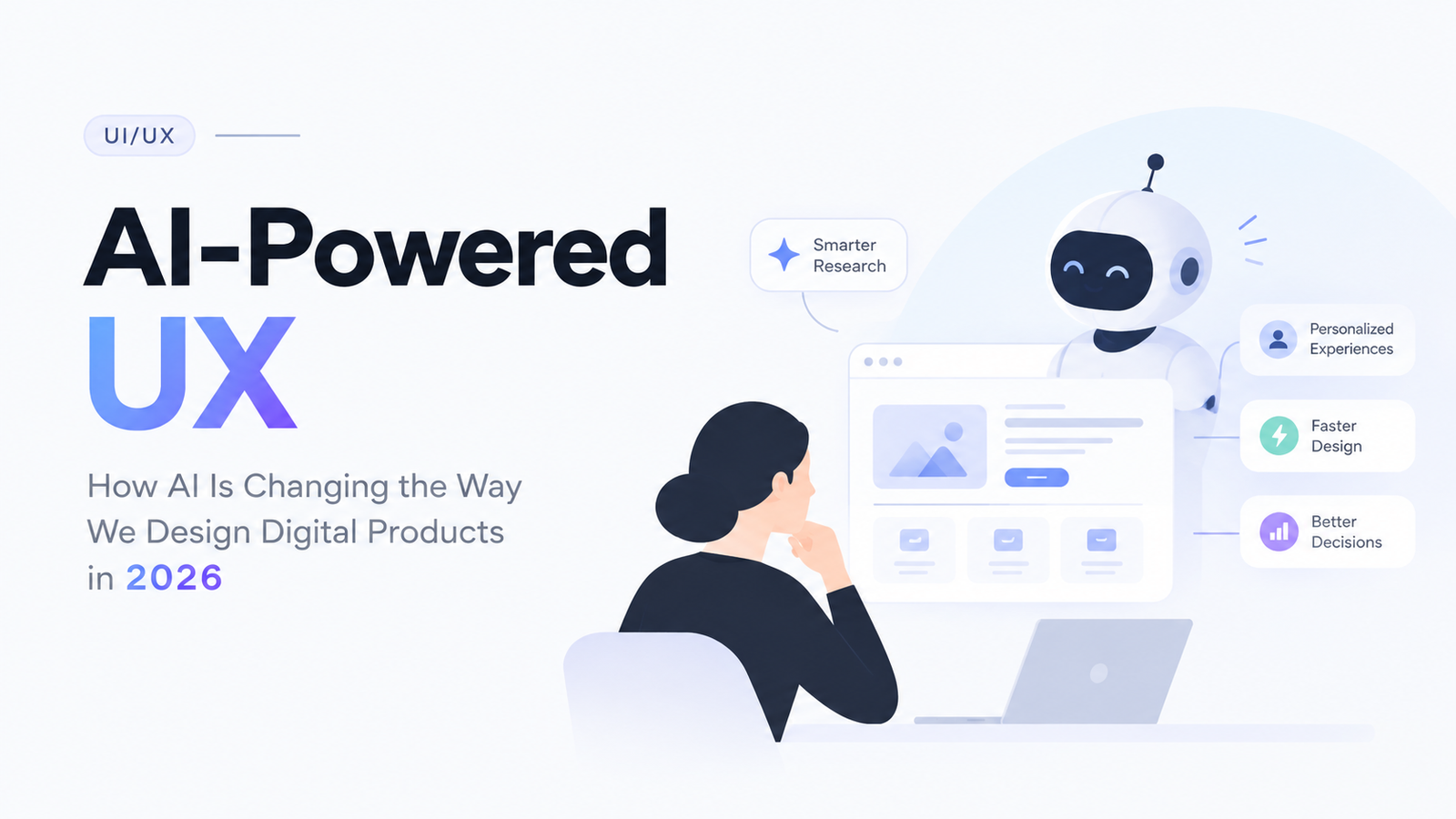
AI-Powered UX: How AI Is Changing the Way We Design Digital Products in 2026
Artificial Intelligence is rapidly changing the way digital products are researched, designed, tested and personalized. In 2026, AI is no longer just a technology trend—it is becoming an important part of the modern UI/UX design workflow.
How AI Is Changing UX Design in 2026
UI/UX design has traditionally involved user research, wireframing, prototyping, usability testing and continuous iteration. AI is now helping designers perform many of these tasks faster while allowing them to spend more time solving complex user problems and making strategic design decisions.
From analyzing user behavior to generating interface ideas and personalizing digital experiences, AI is becoming a powerful assistant for UX designers. However, AI does not replace the need for human-centered design. Instead, designers can use AI to improve their workflow and make better-informed decisions.
1. AI Is Making UX Research Faster
UX research is one of the most important parts of product design. Designers need to understand what users want, what problems they face and why they behave in certain ways.
AI tools can help designers organize research data, identify patterns in user feedback, summarize interviews and highlight recurring pain points. This can reduce repetitive manual work and allow UX designers to focus more on understanding the actual user problem.
2. AI Can Help Generate Design Ideas
Designers often explore multiple concepts before selecting the right direction. Generative AI can help create early design ideas, layouts, content structures and visual directions much faster.
Instead of starting every concept from a blank screen, designers can use AI as a brainstorming partner and then refine the ideas according to user needs, brand guidelines and usability principles.
3. Faster Wireframing and Prototyping
Wireframes and prototypes help designers test the structure and flow of a digital product before development begins. AI-assisted design workflows can speed up the process of converting ideas into initial layouts and interactive concepts.
This allows teams to experiment with different user flows and make changes earlier in the product development process.
4. Personalized User Experiences
One of the biggest opportunities created by AI is personalization. Modern digital products can analyze user behavior and provide more relevant content, recommendations and experiences.
For example, an e-commerce application can recommend products based on previous interactions, while a learning platform can adapt content according to a learner's activity and preferences.
For UX designers, this means designing experiences that can adapt to different users rather than creating exactly the same experience for everyone.
5. AI Can Improve Usability Testing
Usability testing helps designers discover where users struggle with a product. AI can assist in analyzing large amounts of interaction data and identifying patterns that may require further investigation.
Designers can use these insights to identify confusing navigation, interaction problems and areas where users may be dropping out of a particular flow.
6. AI Is Changing the Role of UX Designers
As AI takes care of more repetitive design tasks, the role of a UX designer is becoming increasingly focused on problem-solving, research, strategy and understanding human behavior.
A successful designer in 2026 needs more than knowledge of design software. Understanding users, business goals, accessibility, design systems, usability and AI-assisted workflows is becoming increasingly important.
Will AI Replace UI/UX Designers?
AI can automate certain tasks, but good UX design requires understanding people, context, business objectives and real-world problems.
Designers still need to decide what problem should be solved, which solution makes sense for users and how the final experience should work. AI can support these decisions, but human judgment and empathy remain important parts of user-centered design.
Skills UI/UX Designers Should Learn in 2026
- UX Research
- User Personas and User Journeys
- Information Architecture
- Wireframing
- Prototyping
- Usability Testing
- Design Systems
- Responsive UI Design
- Accessibility
- AI-assisted Design Workflows
- Figma and modern UX tools
- UX Case Studies and Portfolio Building
Want to Learn UI/UX Design? Explore UI/UX Institute
If you want to build a career in UI/UX design, learning through practical projects and building a strong portfolio can be an important part of your journey.
UI/UX Institute in Laxmi Nagar, Delhi offers UI/UX training with a portfolio-first, project-based approach. According to the institute, students work on practical projects, receive mentor feedback and can get support with resume preparation, interview preparation and career development.
The institute's UI/UX learning ecosystem covers areas such as UX research, wireframing, prototyping, usability testing and UX case studies. It also provides training around tools used in modern UX workflows.
UI/UX Institute – Delhi
Website: uiuxinstitute.in
Phone / WhatsApp: +91 92202 67838
Address: G-52, 1st Floor, Opp. Red Tape, Metro Pillar 42, Laxmi Nagar, Delhi – 110092
If you're looking for a UI/UX course in Delhi, you can visit the institute, discuss your learning goals with the counselling team and check the current curriculum, batch timings and course details before enrolling.
Explore UI/UX CoursesThe Future of UI/UX Design Is Human + AI
AI is changing the design process, but the fundamentals of good UX remain the same: understand the user, identify the real problem, create a simple solution and continuously test and improve it.
In 2026, the designers who understand both human-centered design and AI-assisted workflows will be better prepared to work on the next generation of websites, mobile applications and digital products.
The future of UX is not simply about designing faster. It is about using technology intelligently while keeping real human needs at the center of every digital experience.